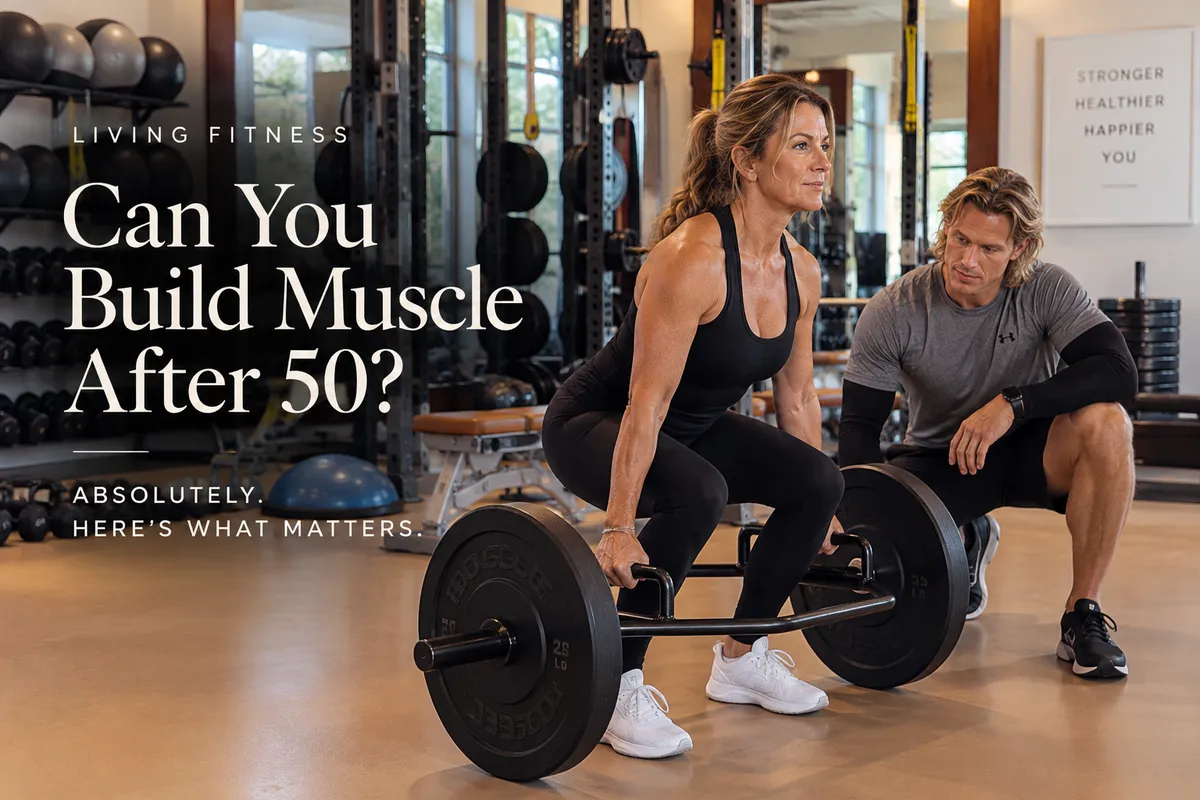
1. Can You Build Muscle After 50? Absolutely. Here’s What Matters.
If you’re over 50 and wondering whether it’s too late to build muscle, here’s the good news:
It isn’t.
Your body may not respond exactly the way it did when you were 25, but your muscles have not lost their ability to become stronger, adapt and grow.
In fact, research shows that adults well beyond 50 can increase actual muscle size through resistance training. A 2024 systematic review and meta-analysis of adults 65 and older found significant increases in both whole-muscle size and muscle-fiber size following resistance training.
That means the question isn’t really:
“Am I too old to build muscle?”
A better question is:
“Am I giving my body the right reasons to build it?”
Because after 50, how you train matters.
At Living Fitness, we’ve been helping people become stronger at our Newport Coast personal training studio since 2004. Many of the clients we work with are in their 40s, 50s, 60s and beyond—and one of the biggest misconceptions we encounter is the idea that there comes a point when you’re simply “too old” to build muscle.
The science tells us otherwise.
What Changes After 50 — and What Doesn’t
There are real physiological changes that occur as we age.
We gradually become more susceptible to losing muscle. Recovery may change. And for women, the hormonal changes associated with perimenopause and menopause can add another layer to changes in body composition.
But none of this means your muscles stop responding to training.
A 2024 systematic review and meta-analysis of resistance training in healthy postmenopausal women found significant improvements in both upper- and lower-body strength.
And the broader evidence for resistance training is remarkably strong.
The American College of Sports Medicine’s 2026 position stand synthesized 137 systematic reviews involving more than 30,000 participants and concluded that resistance training improves muscle strength, muscle size, power, balance, gait speed and multiple measures of physical function.
So yes, your body changes with age.
The way you train should change with it.
But your ability to become stronger is still very much there.
After 50, Muscle Is About So Much More Than Appearance
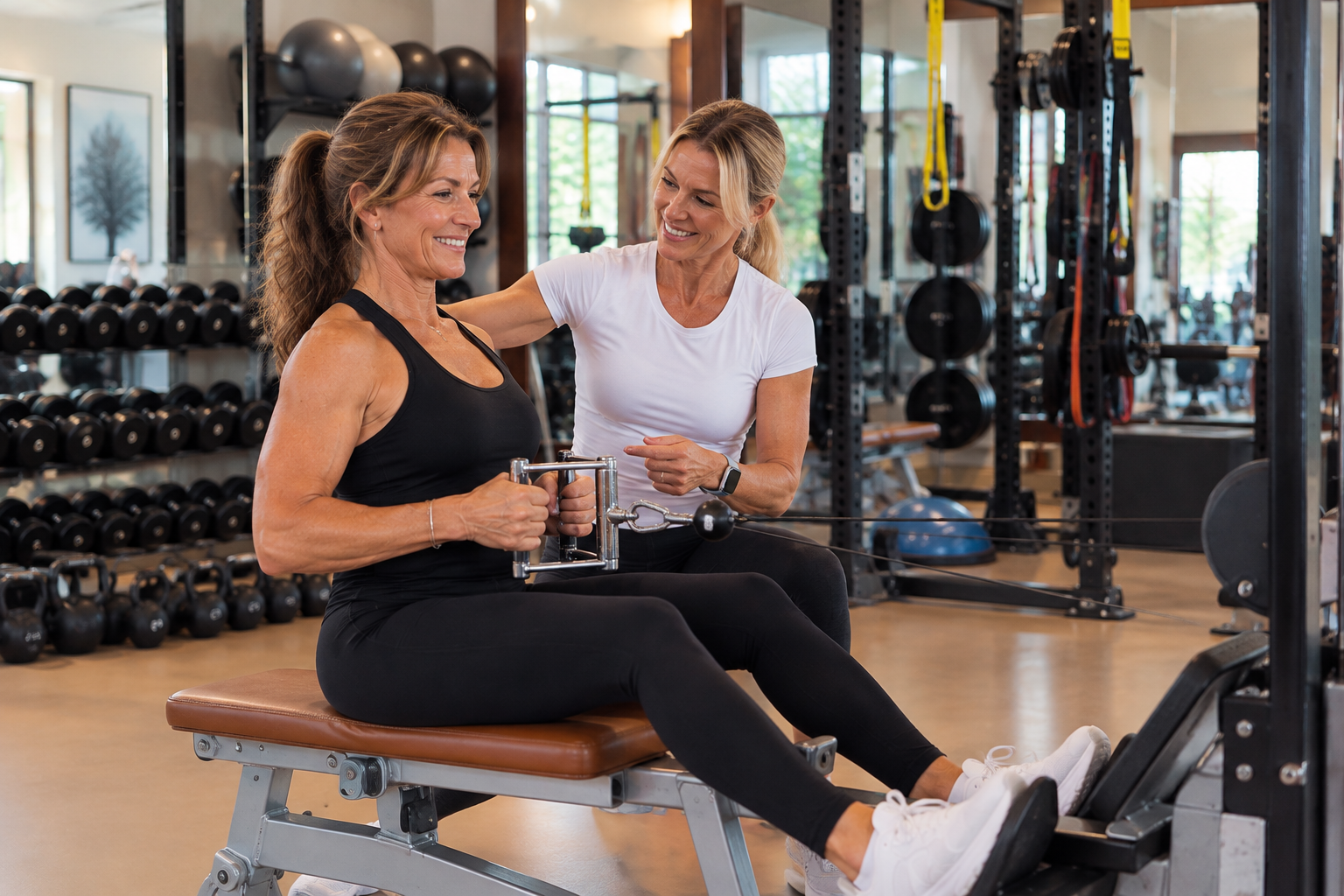
When you’re younger, you may think about building muscle primarily in terms of how your body looks.
After 50, the conversation becomes much bigger.
Muscle helps you climb stairs, carry groceries, lift a suitcase into an overhead compartment, get up from the floor, play with your grandchildren, enjoy your favorite sports and continue doing the things you love.
Resistance training can also improve physical abilities such as balance, gait speed and other measures of everyday function.
Yes, building muscle can change the way your body looks.
But ultimately:
We train for muscle because it can change the way your body ages.
At Living Fitness, that’s why we like to ask:
What are you training for?
Maybe it’s tennis.
Maybe it’s skiing.
Maybe it’s traveling.
Maybe it’s keeping up with your kids or grandkids.
Maybe you want to feel more confident carrying your own luggage, getting up from the floor or tackling a flight of stairs.
Or maybe you simply want to look in the mirror and see a strong, capable body looking back at you.
Those are all good reasons to train.
Progressive Resistance Training Is the Signal
Here’s where many people get stuck.
Exercising and training aren’t necessarily the same thing.
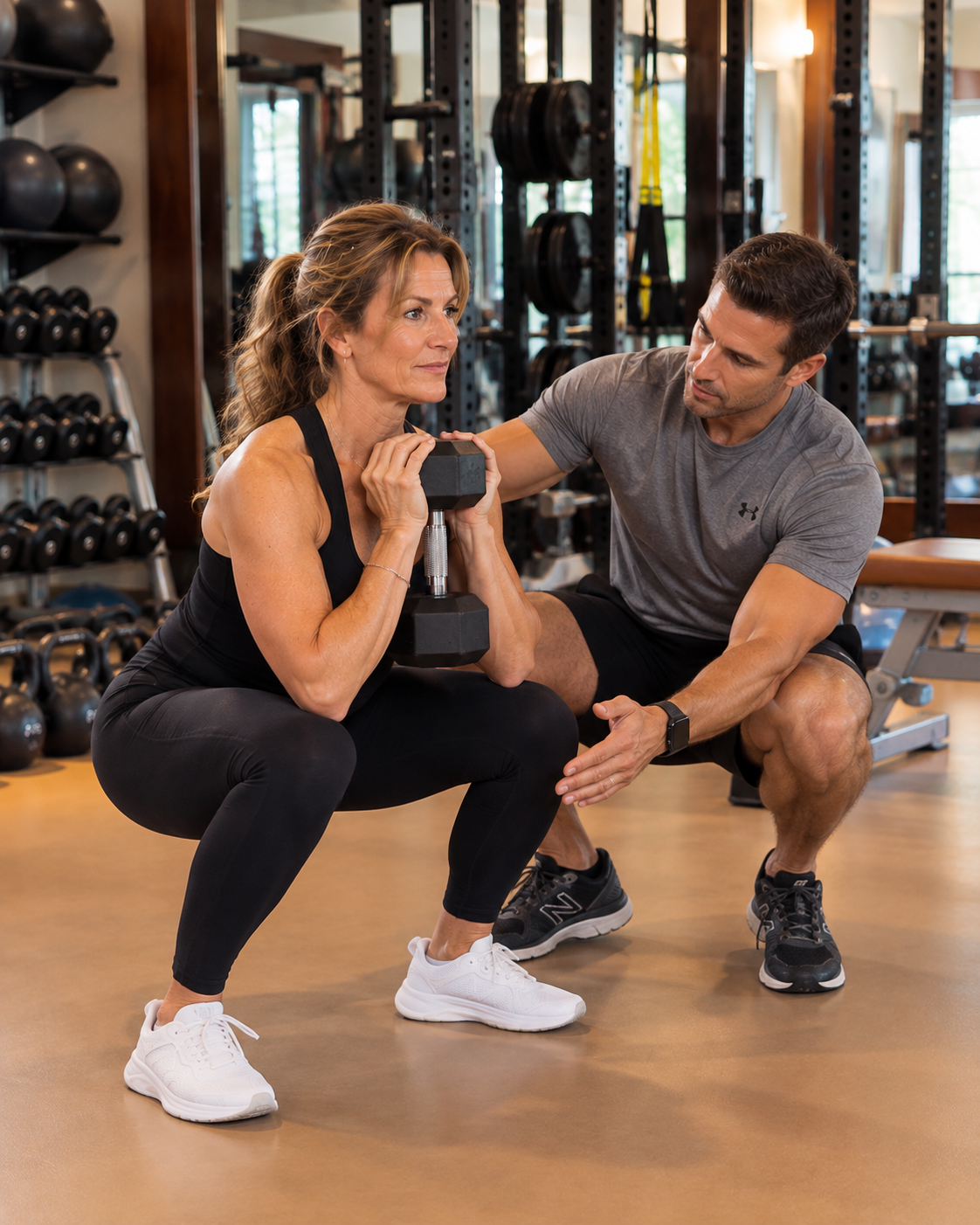
You can walk, take fitness classes, do different workouts every week and be very physically active. All of that movement can have value.
But if your goal is specifically to build muscle, your muscles need an adequate resistance-training stimulus.
They need a reason to adapt.
This is where progressive overload comes in.
As your body adapts to a particular challenge, that challenge gradually needs to progress. That might mean increasing the resistance, performing additional repetitions or sets, improving range of motion, advancing an exercise or adjusting other training variables.
Current evidence strongly supports progressive resistance training for improving muscle size, strength and physical performance. The latest ACSM review also found that greater weekly training volume can enhance muscle hypertrophy.
This doesn’t mean you have to lift the heaviest weights in the gym.
And you certainly don’t have to train like a bodybuilder.
It means that over time, your body needs to be appropriately challenged beyond what it has already adapted to.
That’s why doing the exact same workout with the exact same weights month after month isn’t an ideal muscle-building strategy.
Your body adapts when you progressively ask it to do more.
Random Workouts Aren’t the Same as Progressive Training
There’s nothing inherently wrong with trying different workouts.
But variety by itself isn’t a muscle-building strategy.
If your exercises constantly change, your resistance isn’t tracked and there’s no progression from one training phase to another, it becomes difficult to know whether you’re actually getting stronger.
That’s why at Living Fitness, we distinguish between simply working out and training.
A workout is something you do today.
Training is part of a plan.
We want to know what you did last week, what you’re capable of today and what we should progressively ask your body to do next.
That’s where progress happens.
ASSESS → PROGRAM → TRAIN → TRACK → PROGRESS
Protein Matters, Too
Training provides the stimulus.
Nutrition helps provide the building blocks.
Protein supplies the amino acids your body uses to repair and build muscle tissue, making adequate protein especially important when resistance training is part of your routine.
A large systematic review and meta-analysis involving 49 studies found that protein supplementation enhanced resistance-training-induced improvements in muscle mass and strength. In that analysis of healthy adults, additional benefits to fat-free mass tended to level off around a total protein intake of approximately 1.6 grams per kilogram of body weight per day, although individual needs vary.
That doesn’t mean everyone over 50 needs to obsessively count every gram of protein.
It does mean that if building or preserving muscle is important to you:
Protein shouldn’t be an afterthought.
At Living Fitness, we like to think about nutrition through a muscle-first lens:
Are you eating in a way that supports the body you’re asking your training to build?
But protein alone isn’t the answer.
Resistance training provides the stimulus.
Nutrition provides the support.
You need both.
Consistency May Matter More Than Your Birthday
One of the most encouraging things about the research on older adults is just how adaptable muscle remains.
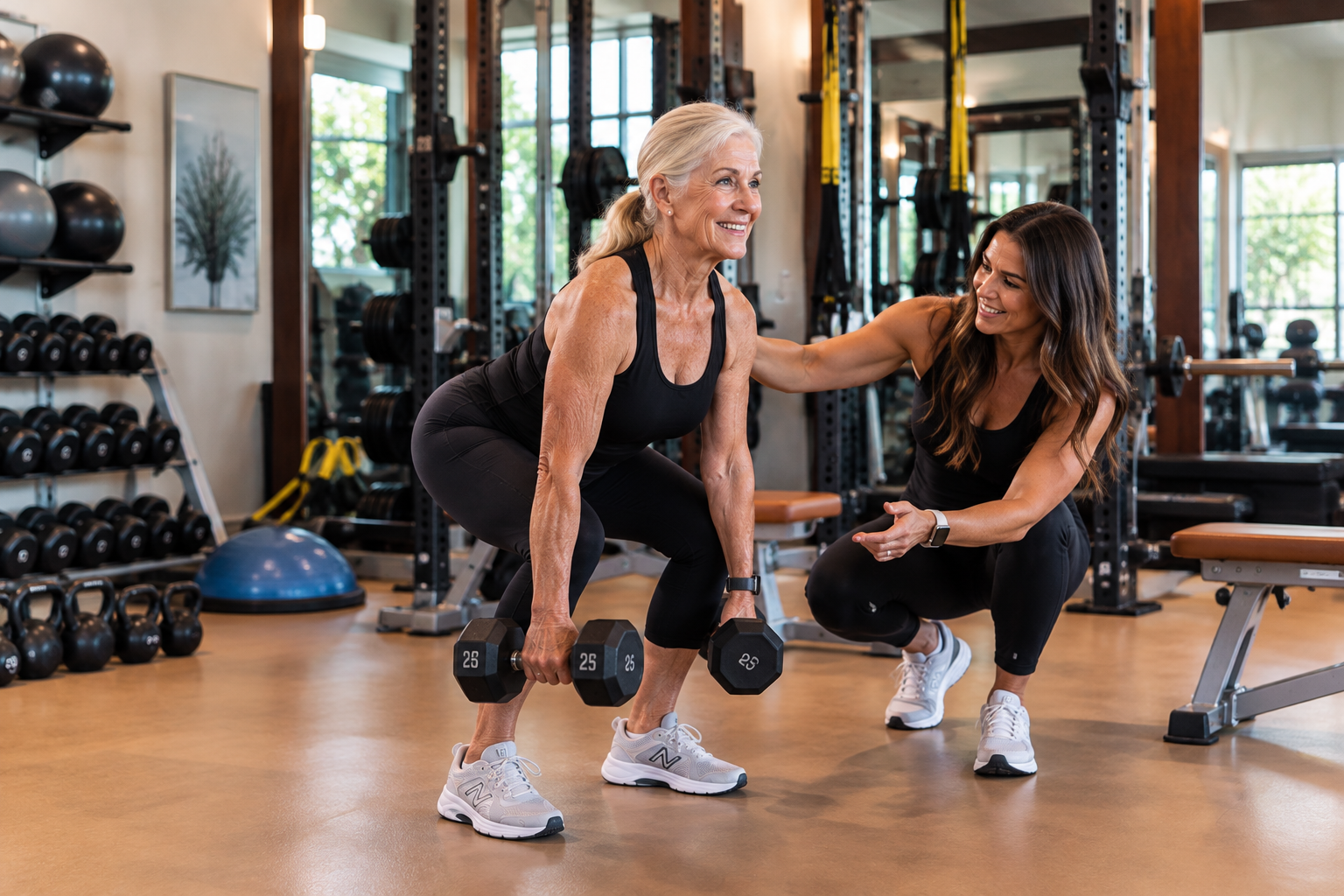
In the 2024 analysis of adults 65 and older, resistance training increased both whole-muscle and muscle-fiber size. Within the studies analyzed, age itself did not significantly explain differences in hypertrophy, while training duration influenced some muscle-fiber growth outcomes.
That doesn’t mean age is physiologically irrelevant.
It means being older doesn’t automatically prevent you from responding to training.
Your birthday isn’t something you can control.
Your consistency is.
You don’t need six perfect weeks followed by six weeks of doing nothing.
You need a training approach you can sustain long enough for your body to adapt.
Why Working With a Personal Trainer After 50 Can Be Especially Valuable
Knowing that you should strength train is one thing.
Knowing what exercises to do, how much weight to use, how much training volume you need, when to progress and how quickly to progress is another.
This is where working with an experienced personal trainer can be especially valuable.
A well-designed strength program isn’t simply a collection of exercises.
Exercise selection, resistance, repetitions, training volume and progression should make sense for your body, your current abilities and your goals.
A good trainer can determine where you’re starting, select appropriate exercises, teach you how to perform them correctly and progressively increase the challenge as your body becomes stronger.
And that progression matters.
Muscle needs a reason to grow. But more isn’t automatically better.
If the training stimulus isn’t challenging enough, you may not provide your muscles with enough reason to adapt.
But adding too much load too quickly or progressing an exercise before your body is ready isn’t the answer either.
This can be particularly important after 50 because most of us aren’t starting with a blank slate.
Maybe you haven’t strength trained in 10 years.
Maybe you have an old knee, shoulder or back issue.
Maybe you’ve stayed active but have never followed a structured resistance-training program.
Or perhaps you’re already quite fit but want to train more intelligently as you get older.
An experienced trainer can help you find that important middle ground:
Enough challenge to stimulate adaptation, with a rate of progression appropriate for you.
That may mean spending time developing foundational strength, stability, mobility, technique and movement competency before certain exercises or heavier loads make sense.
No training program can eliminate the possibility of injury. But appropriate exercise selection, good technique and sensible progression can help you avoid taking on demands your body isn’t yet prepared for.
Because an injury that keeps you from training for weeks or months doesn’t move you closer to your goal.
The goal isn’t to see how much you can do today. It’s to build a body capable of doing more tomorrow.
That’s why personal training at Living Fitness isn’t about giving you a different hard workout every time you walk through the door.
We assess.
We program.
We coach.
We track.
And as your body adapts, we progress.
Smart progression doesn’t mean taking it easy because you’re over 50.
It’s how you keep moving forward.
At our Newport Coast studio, we work with clients throughout Newport Beach who come to us at very different starting points. Some have been lifting weights for decades. Others haven’t exercised consistently in years.
You don’t have to arrive strong. You come here to become stronger.
Personal Training At Living Fitness.
Do You Have to Train to Failure to Build Muscle?
No.
You need to challenge your muscles, but you don’t have to destroy them.
The 2026 ACSM evidence review found that training to momentary muscle fatigue or failure did not consistently improve training outcomes.
That’s an important message, particularly if you haven’t exercised in years.
You don’t need to leave every workout barely able to walk.
You don’t need the most complicated exercises.
And soreness isn’t a scorecard for whether your workout “worked.”
Better programming beats simply doing more exercise.
What If You Haven’t Exercised in Years?
Then we start where you are.
You do not need to get in shape before you begin strength training.
That’s what training is for.
The appropriate training stimulus for someone who has trained consistently for 20 years will be very different from the appropriate stimulus for someone returning after a decade away.
Your first goal may be learning movement patterns, developing control and establishing foundational strength.
Then we build from there.
You don’t have to prove that you’re fit enough to begin.
You begin so that you can become fit.
What About Women After Menopause?
This deserves special attention because so many women reach their 50s and feel as though their bodies suddenly stopped responding.
They didn’t.
Menopause is accompanied by physiological changes, and body composition can change during this stage of life. But resistance training remains an important tool.
A 2024 systematic review and meta-analysis of healthy postmenopausal women found significant improvements in both upper- and lower-body strength following resistance training.
So if you’re a woman in your 50s, 60s or beyond, this isn’t the time to give up on building muscle.
It’s an excellent time to make muscle a priority.
Instead of asking only:
“How can I weigh less?”
Consider asking:
“How can I become stronger, build or preserve muscle, and improve what my body is capable of?”
That’s a very different goal.
And it can completely change the way you approach fitness.
So, Can You Build Muscle After 50?
Absolutely.
Can you build muscle after 60?
Yes.
After 70?
Research in adults 65 and older tells us that muscle can still hypertrophy in response to resistance training. Research has even found significant improvements in muscle size and strength among adults 75 and older.
The goal isn’t to pretend aging doesn’t exist.
It does.
The goal is to understand that:
Aging and getting stronger are not mutually exclusive.
What matters is giving your body the signals it needs:
Progressive resistance training. Adequate protein. Appropriate recovery. Smart progression. Consistency over time.
You are not too old to get stronger.
And you don’t have to punish your body into submission to make it happen.
You need to give your body an intelligent reason to become stronger.
Personal Training At Living Fitness.
Looking for Personal Training in Newport Beach?
Your Strongest Years Don’t Have to Be Behind You.
Building muscle after 50 doesn’t happen by accident. It takes the right training stimulus, adequate nutrition, smart progression and consistency over time.
But you don’t have to figure all of that out on your own.
Living Fitness is a boutique personal training studio located in Newport Coast, serving Newport Beach and the surrounding communities. Since 2004, we’ve helped clients become stronger through personalized, coach-led training built around their individual goals, abilities and starting points.
Whether you’re new to strength training, returning after years away, or already active and ready to become stronger, we’ll help you train with purpose—and with a plan.
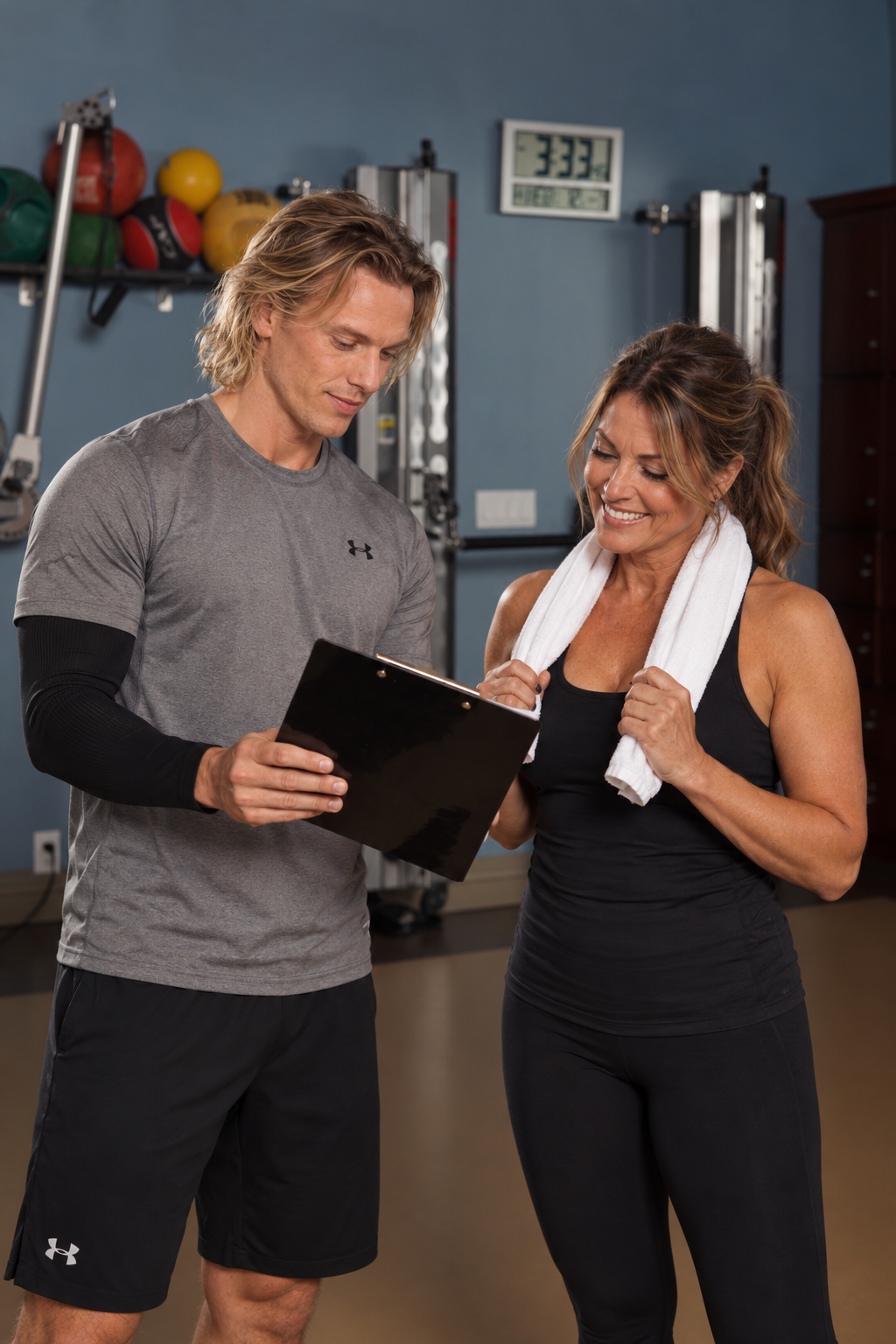
Ready to see what getting stronger could look like for you?
GET STARTED
Research & References
[1] Santana DA, et al. Lower extremity muscle hypertrophy in response to resistance training in older adults: Systematic review, meta-analysis, and meta-regression of randomized controlled trials. Experimental Gerontology. 2024.
[2] González-Gálvez N, et al. Resistance training effects on healthy postmenopausal women: a systematic review with meta-analysis. Climacteric. 2024.
[3] Currier BS, et al. American College of Sports Medicine Position Stand. Resistance Training Prescription for Muscle Function, Hypertrophy, and Physical Performance in Healthy Adults: An Overview of Reviews. Medicine & Science in Sports & Exercise. 2026.
[4] Morton RW, et al. A systematic review, meta-analysis and meta-regression of the effect of protein supplementation on resistance training-induced gains in muscle mass and strength in healthy adults. British Journal of Sports Medicine. 2018.
[5] Grgic J, et al. Effects of Resistance Training on Muscle Size and Strength in Very Elderly Adults: A Systematic Review and Meta-Analysis of Randomized Controlled Trials. Sports Medicine. 2020.
