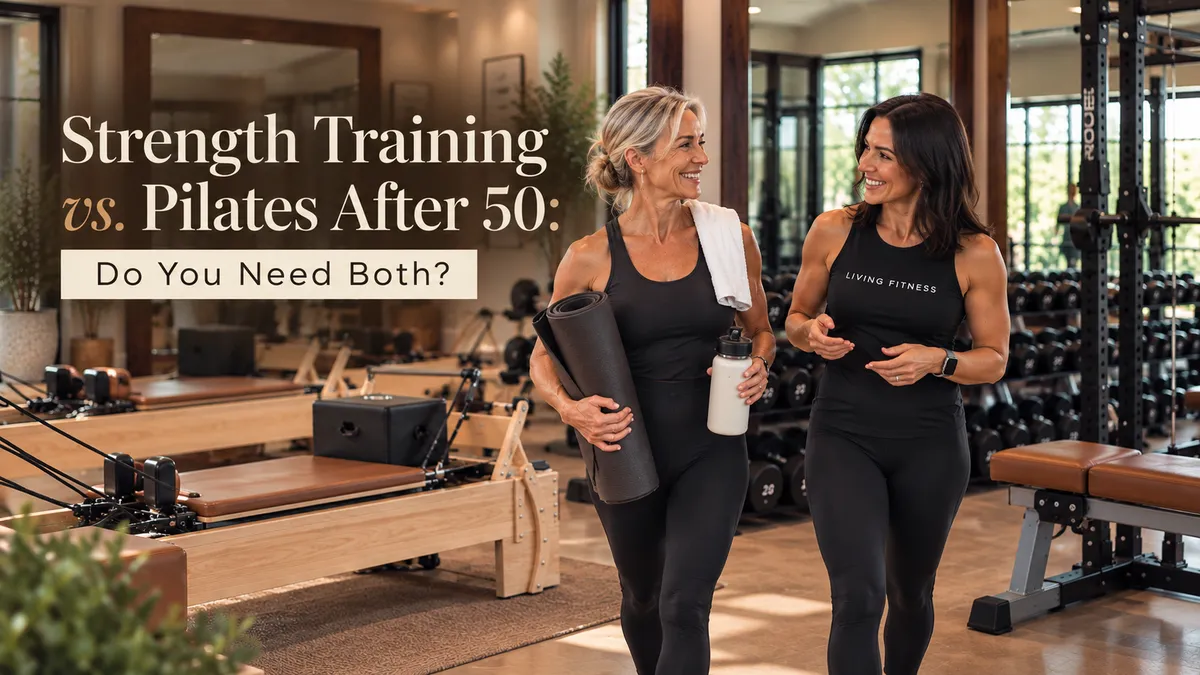
3. Strength Training vs. Pilates After 50: Do You Need Both?
If you're over 50 and trying to decide how to exercise, you've probably heard plenty of conflicting advice.
You need to lift weights.
You should do Pilates.
You need more mobility.
You need to work on your core.
You need to build muscle.
So which is it?
Strength training or Pilates?
The answer depends on what you're trying to accomplish.
Because although strength training and Pilates share some benefits, they aren't interchangeable.
If your primary goal after 50 is to build or preserve muscle and become progressively stronger, resistance training deserves an important place in your fitness program.
But Pilates offers benefits of its own—particularly for things like balance, control, stability, flexibility and body awareness—and can complement a well-designed strength program beautifully. Research in adults over 60 has found improvements in several of these areas with Pilates training.
So perhaps the better question isn't:
“Which one is better?”
It's:
“What does my body need from each?”
First, Let's Understand What Strength Training Actually Does
Strength training creates resistance that your muscles must overcome.
As your body adapts, that resistance can progressively increase through heavier loads, additional repetitions or sets, more challenging exercise variations and other programming variables.
That progressive challenge is important because:
Your body needs a reason to adapt.
And we have strong evidence that older muscle still does exactly that.
A 2024 systematic review and meta-analysis examining supervised resistance training in adults 65 and older found significant increases in both whole-muscle size and muscle-fiber area.
The American College of Sports Medicine's 2026 position stand also concluded that resistance training improves muscular strength, hypertrophy, power and physical function across healthy adults.
That's one reason we're so passionate about strength training at Living Fitness.
As we get older, the goal shouldn't simply be to move more.
We also want to maintain the physical capacity to do more.
Strength gives you options.
It helps you lift.
Carry.
Push.
Pull.
Get up.
Climb.
Travel.
Play sports.
And continue doing the things that make your life feel like your life.
So What Does Pilates Do?
Pilates approaches the body differently.
Rather than simply asking how much resistance you can move, Pilates places considerable emphasis on control, alignment, breathing, precision and the quality of movement.
Depending on the exercise and equipment being used, Pilates can challenge strength and muscular endurance too.
Research in older adults has found evidence that Pilates can improve areas such as balance, flexibility and physical function.
A more recent 2024 systematic review and meta-analysis involving 39 studies and 1,770 older adults found that Pilates improved measures of static and dynamic postural balance compared with control groups, although the certainty of the evidence ranged from very low to moderate.
And this is an important point:
Pilates isn't “just stretching.”
A well-taught Pilates session can be incredibly challenging.
It can ask you to stabilize one part of your body while moving another.
It can expose areas where you lack control.
It can challenge your trunk and core musculature.
It can require coordination, balance and precision.
And because movements are performed with attention to positioning and control, Pilates can help you become more aware of how your body moves.
Those are valuable qualities at any age.
Can Pilates Build Strength?
Yes—but this is where we need some nuance.
Pilates absolutely provides resistance.
Your own body weight, springs and the Pilates apparatus can all create muscular challenge.
Someone who is new to exercise may become noticeably stronger from Pilates.
But if your primary objective is to progressively build significant muscle and overall strength, traditional Pilates isn't necessarily a replacement for a well-designed progressive resistance training program.
A 2024 systematic review examining Pilates and strength, endurance and power in adults over 60 found that the evidence was not strong enough to recommend Pilates specifically as a method for improving those outcomes. The authors noted limitations in the quality and consistency of the available research.
Compare that with resistance training, where evidence shows measurable hypertrophy at both the whole-muscle and muscle-fiber level in adults 65 and older.
So I wouldn't frame this as:
Pilates doesn't build strength.
That's too simplistic.
I'd frame it this way:
Pilates can make you stronger. Progressive resistance training gives us a particularly direct and measurable way to progressively build muscle and strength.
That's an important distinction.
What About Your Bones?
This is especially important for women after menopause.
Weight-bearing activity and resistance exercise are commonly included in exercise approaches aimed at supporting bone health.
Pilates may contribute to a well-rounded exercise program, but we should be careful about claiming that Pilates alone will build bone density.
A systematic review and meta-analysis specifically examining Pilates and bone mineral density in postmenopausal women found no significant improvements in bone mineral density at the lumbar spine, total hip or femoral neck compared with controls. Only three randomized trials qualified for the analysis, however, and the authors emphasized that the limited number and quality of studies make firm conclusions difficult.
So if bone health is an important reason you're exercising after 50, I wouldn't rely on Pilates alone.
That doesn't make Pilates less valuable.
It simply reinforces a theme you'll see throughout this article:
Different forms of exercise create different adaptations.
Can Pilates Replace Strength Training After 50?
If your primary goal is to build and preserve as much muscle and strength as reasonably possible:
I wouldn't use Pilates as a complete replacement for progressive resistance training.
That doesn't mean you need to become a powerlifter.
It doesn't mean you need to lift the heaviest weights in the gym.
And it certainly doesn't mean you need to stop doing Pilates.
It means your body should receive an appropriate, progressive resistance-training stimulus somewhere in your week.
We covered exactly how often that might look in our guide:
“How Often Should You Strength Train After 50?”
For many adults, two to three well-designed strength-training sessions per week can be an excellent target.
Can Strength Training Replace Pilates?
Here's where the answer gets interesting.
You don't need Pilates in order to have a great fitness program.
A well-designed strength-training program can incorporate mobility, stability, balance, core work and movement through different ranges of motion.
So I wouldn't tell someone that everyone over 50 needs Pilates.
But that doesn't mean Pilates can't make a strength-training program better for the right person.
Some people love the precision of Pilates.
Some benefit from spending additional time on control, stability and body awareness.
Some simply enjoy the way Pilates makes their body feel and move.
And enjoyment matters.
Because the best exercise program in the world isn't particularly useful if you hate doing it and eventually stop.
You don't have to choose a team.
Strength training and Pilates can coexist.
Strength Training vs. Pilates After 50: What's the Difference?
Strength Training | Pilates |
Progressively builds strength | Develops control and movement quality |
Provides a direct pathway for progressive overload | Uses controlled resistance and precise |
Strong evidence for building muscle in older adults | Can improve balance and physical function |
Trains major movement patterns under increasing resistance | Strong emphasis on core control and stability |
Resistance can be objectively progressed and tracked | Emphasizes alignment, coordination and body awareness |
Important component of a muscle-first approach | Excellent complement to strength training |
So, Do You Need Both After 50?
No. You don't have to do both.
But for many people, combining them can create an excellent training program.
Think of it this way:
Strength training helps build the engine. Pilates can help you control the machine.
Strength training gives your muscles a progressive reason to become stronger.
Pilates can challenge control, stability, balance, mobility and awareness of how you're moving.
And there can be overlap between them.
This isn't about putting exercises into rigid boxes.
It's about asking:
What does my body need?
What are my goals?
What am I already doing?
What am I missing?
And what type of training will I actually enjoy enough to continue?
That's a much better way to build a fitness program after 50.
What If You're Returning to Exercise After Years Away?
This is one of my favorite applications of combining Pilates and strength training.
If you haven't exercised consistently in years, walking into a gym and immediately trying to perform a full traditional strength workout can feel intimidating.
You may also feel like your body doesn't move the way it used to.
Your balance may feel different.
Your core may feel weaker.
You may feel stiff.
Or you may simply have lost confidence in what your body can do.
That doesn't mean you need to “get in shape” before you begin.
It means we start where you are.
For some people, combining Pilates with introductory strength training can provide a comfortable bridge back into exercise.
You can work on control, stability, mobility and movement quality while simultaneously beginning to introduce resistance.
Then, as you become stronger and more confident, your training can progress.
Private Pilates Makes the Details Personal
There's another reason we offer Pilates privately at Living Fitness.
Pilates is highly technique-dependent.
Small changes in alignment, breathing, positioning and muscle activation can change the way an exercise feels—and which muscles are doing the work.
In a private session, the instructor can watch every repetition.
They can adjust your positioning.
Change the resistance.
Modify an exercise.
Progress it when you're ready.
And tailor the session to how your body is moving that day.
There's a big difference between being in a Pilates class and having a Pilates instructor focused entirely on you.
For 55 minutes, the session is yours.
What Should Your Week Actually Look Like?
There's no single perfect formula.
For one person, a great week might include:
2 strength-training sessions + 1 Pilates session
For another:
3 strength-training sessions + 1 Pilates session
For someone returning after a long break:
1 private strength session + 1 Pilates or 30/30 session
And for someone who simply loves Pilates, it might mean continuing Pilates several times per week while making sure progressive strength training also has a place in the schedule.
The right combination depends on the person—not their birthday.
Your goals matter.
Your training history matters.
Your schedule matters.
Your recovery matters.
Your preferences matter.
And where you're starting today matters.
That's one of the biggest advantages of personalized training.
We don't have to fit your body into somebody else's workout plan.
We can build the plan around your body.
The Bigger Picture: Don't Just Exercise. Build a Body for Your Life.
After 50, exercise starts to mean something different.
It's not just about burning calories.
And it shouldn't only be about trying to make your body smaller.
It's about maintaining—and ideally increasing—your physical capacity.
Can you carry your luggage?
Can you get up from the floor?
Can you hike on vacation?
Can you play tennis?
Can you lift something heavy when life asks you to?
Can you trust your balance?
Can you keep doing the things you love?
That's what we're ultimately training for.
If building muscle is part of that goal, progressive resistance training matters.
If moving with greater control, stability and awareness is valuable to you, Pilates can be an excellent addition.
And if you love both?
There's absolutely room for both.
Looking for Strength Training or Private Pilates in Newport Beach?
You Don't Have to Choose the “Perfect” Workout. You Need the Right Program for You.
Living Fitness is a boutique personal training studio located in Newport Coast, serving Newport Beach and the surrounding communities.
Since 2004, we've helped clients become stronger, move better and stay active through highly personalized coaching.
Whether you're interested in 1:1 personal training, private Pilates, or a combination of both through 30/30, we'll help you determine the right starting point based on your goals, experience and current abilities.
Not sure which approach is right for you?
GET STARTED
Research & References:
[1] Pilates improves physical performance and decreases risk of falls in older adults: a systematic review and meta-analysis. The review included 39 studies in adults 60+ and found improvements in balance, strength, flexibility and physical function compared with control conditions, although certainty varied by outcome. PubMed
[2] Campos Júnior JF, et al. Effects of Pilates exercises on postural balance and reduced risk of falls in older adults: A systematic review and meta-analysis. Complementary Therapies in Clinical Practice. 2024. The analysis included 39 studies and 1,770 participants and found improvements in several measures of static and dynamic balance compared with controls, with very low-to-moderate certainty evidence. PubMed
[3] Santana DA, et al. Lower extremity muscle hypertrophy in response to resistance training in older adults: Systematic review, meta-analysis, and meta-regression of randomized controlled trials. Experimental Gerontology. 2024. Resistance training significantly increased whole-muscle size and muscle-fiber area in adults 65+. PubMed
[4] Currier BS, et al. American College of Sports Medicine Position Stand. Resistance Training Prescription for Muscle Function, Hypertrophy, and Physical Performance in Healthy Adults: An Overview of Reviews. Medicine & Science in Sports & Exercise. 2026. ACSM
[5] Oliveira LS, et al. Effects of Pilates exercises on strength, endurance and muscle power in older adults: Systematic review and meta-analysis. Journal of Bodywork and Movement Therapies. 2024. The review found the evidence insufficient to recommend Pilates specifically for improving strength, endurance and muscle power in older adults and highlighted limitations in the available evidence. ScienceDirect
[6] de Oliveira RG, et al. Effects of Pilates Exercise on Bone Mineral Density in Postmenopausal Women: A Systematic Review and Meta-analysis. Journal of Geriatric Physical Therapy. 2022. The analysis did not find significant improvements in lumbar spine, total hip or femoral-neck BMD, although only three randomized trials met inclusion criteria and evidence was limited. PubMed
